What Does RAID Stand For in Project Management and Why It Matters
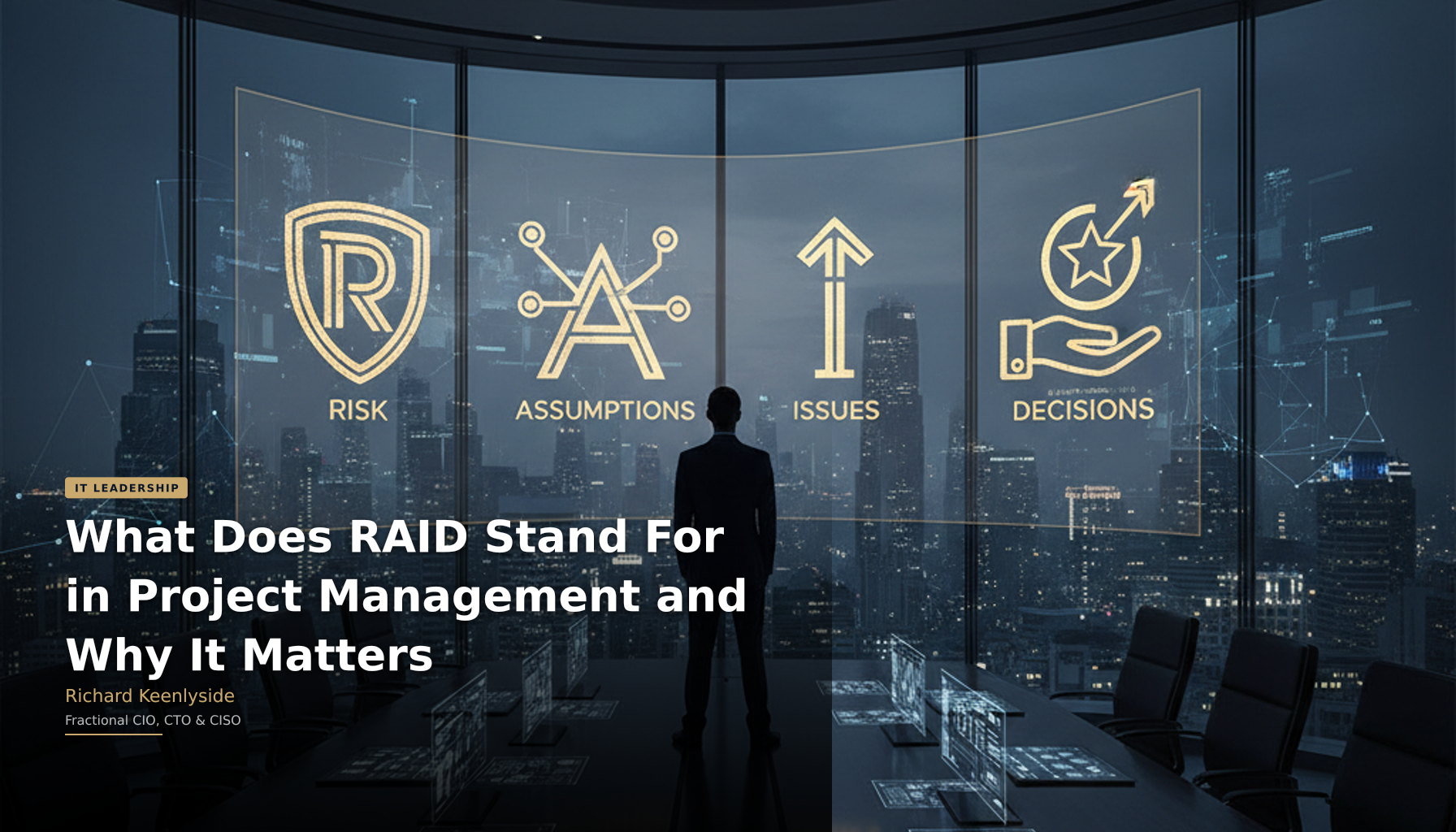
In project management, the RAID acronym is a fundamental tool that helps leaders maintain control and visibility over critical project elements. If you have ever questioned what does RAID stand for project management, you are not alone. In my experience working with scale-ups and enterprise organisations, a well-maintained RAID log can improve project success rates by providing clarity and enabling proactive risk mitigation.
Why Understanding RAID Matters in Project Management
Project failures often stem from overlooked risks, unmanaged issues, untracked assumptions, or unidentified dependencies. These elements can silently derail even the best-planned initiatives. For project sponsors, programme managers, and CIOs, understanding and applying RAID principles is essential to prevent costly delays, overruns, or complete failure.
Without a formal RAID process, teams struggle to communicate risks effectively, resolve issues promptly, or adapt plans to changing circumstances. This lack of visibility causes fragmented decision-making and reactive management, which I have repeatedly seen compromise both timelines and budgets.
What Does RAID Stand For Project Management and Its Components
The RAID acronym stands for four critical aspects of project oversight:
- Risks: Potential events or conditions that could negatively impact the project. These are not certainties but possibilities that require assessment, monitoring, and mitigation strategies.
- Assumptions: Preconditions that are taken for granted during planning. These represent factors assumed true without verification, yet mistaken assumptions can undermine project plans if not identified and reviewed regularly.
- Issues: Current problems encountered during the project that require immediate attention and resolution. Issues demand clear ownership, escalation paths, and action tracking.
- Dependencies: External or internal activities that must be completed before others can proceed. Dependencies influence scheduling, resource planning, and risk exposure.
Each element requires a distinct management approach but shares a common goal: to improve transparency and enable smarter decisions throughout the project lifecycle. A comprehensive RAID log captures these aspects, providing a single reference point for project teams and stakeholders.
Implementing RAID Effectively: Practical Insights
Simply knowing what RAID stands for is not enough. How you embed it into your project management practice determines its value. Here are practical steps I recommend for leveraging RAID to boost project outcomes:
- Establish a RAID log from project initiation. Incorporate it into your governance framework as an official artefact. It should evolve through project phases rather than being a one-off exercise.
- Define clear ownership for each RAID element. Assign accountable individuals for monitoring risks, validating assumptions, resolving issues, and managing dependencies, with regular reporting cycles.
- Make RAID a standing agenda item in project and steering group meetings. This ensures ongoing attention and keeps the conversation focused on actionable insights.
- Use categorisation and prioritisation in your RAID log to highlight critical risks and issues requiring senior intervention or contingency plans.
- Link RAID to your project plan. Dependencies, in particular, affect scheduling; risks and issues impact resource allocation and scope decisions.
Incorporating these practices helps turn RAID from a bureaucratic checklist into a strategic risk management and decision-support tool.
The Real-World Impact of RAID: Patterns from My Experience
One recurring pattern I encounter is projects lacking a structured RAID approach become reactionary rather than proactive. In one recent engagement with a PE-backed scale-up, absence of clear assumptions and dependency tracking led to misaligned vendor and internal delivery schedules. This caused cascading delays, frustrated stakeholders, and threatened the overall go-to-market timeline.
Once we implemented a comprehensive RAID log with assigned owners for each category, visibility improved dramatically. Early identification of key assumptions around third-party integration allowed timely validation and renegotiation. Tracking dependencies enabled the project manager to re-sequence tasks and mitigate schedule risks effectively. This turnaround was critical in delivering the project on a revised but achievable timetable.
This anecdote illustrates how understanding what RAID stands for project management and applying it rigorously can convert uncertainty into informed controls and better outcomes.
Common RAID Mistakes to Avoid
- Using RAID as a static document updated infrequently rather than a living management tool
- Failing to distinguish between risks and issues, leading to confusion over response urgency
- Ignoring assumptions or not revisiting them regularly as project realities evolve
- Neglecting to capture and manage dependencies, causing overlooked sequencing problems
- No clear accountability for RAID items, resulting in unresolved issues and unmanaged risks
- Overloading RAID logs with trivial items that dilute focus on critical concerns
Frequently Asked Questions
What is the difference between risks and issues in RAID?
Risks are potential problems that might occur in the future and require planning to prevent or mitigate. Issues are current problems that have already happened and demand immediate resolution to minimise impact.
How often should a RAID log be updated?
A RAID log should be reviewed and updated regularly throughout the project lifecycle, ideally at every project team meeting or steering committee. This keeps information current and ensures timely action on emerging concerns.
Can RAID be used for all types of projects?
Yes, RAID is a versatile framework suitable for projects across industries and sizes. Its structured approach helps manage uncertainty and complexity, making it valuable from IT implementations to operational improvements.
In summary, when asking what does RAID stand for project management, it is crucial to appreciate its role as a comprehensive framework encompassing Risks, Assumptions, Issues and Dependencies. Recognising these categories and managing them effectively provides the transparency and control essential for successful project delivery. Through disciplined RAID practice, organisations can transform project uncertainty into clarity and maintain momentum toward their strategic goals.
How Richard Can Help
Need Experienced Technology Leadership?
Whether you need an interim CIO to stabilise operations, a fractional CIO for strategic oversight, or a trusted technology advisor to challenge your current direction, I work alongside leadership teams to deliver real outcomes. With over 37 years of experience across UK and international organisations, I provide the depth of expertise your business needs.