Understanding the Most Common Types of Hacking and Their Impact
Hacking types continue to evolve, presenting ever greater challenges for organisations and individuals alike. In my experience advising businesses across sectors, I have observed that over 60 per cent of security incidents stem from a few prevalent hacking methods, often exploiting overlooked vulnerabilities. Understanding these common attacks is essential for effective defence and risk management.
Why Understanding Hacking Types Matters
The security landscape is increasingly complex, with organisations facing constant threats from diverse attack vectors. Businesses without a clear grasp of the hacking types targeting them risk severe operational disruption, financial loss, and reputational damage. This is especially true for scale-ups and private equity-backed firms where technology is integral to value creation and exit strategies.
Without comprehensive awareness and preparation, critical data may be exposed or lost, regulatory compliance compromised, and stakeholder trust undermined. Executives and board members must therefore prioritise understanding which hacking techniques are most relevant to their context, to ensure that security investments deliver tangible protection.
Common Hacking Types: What You Need To Know
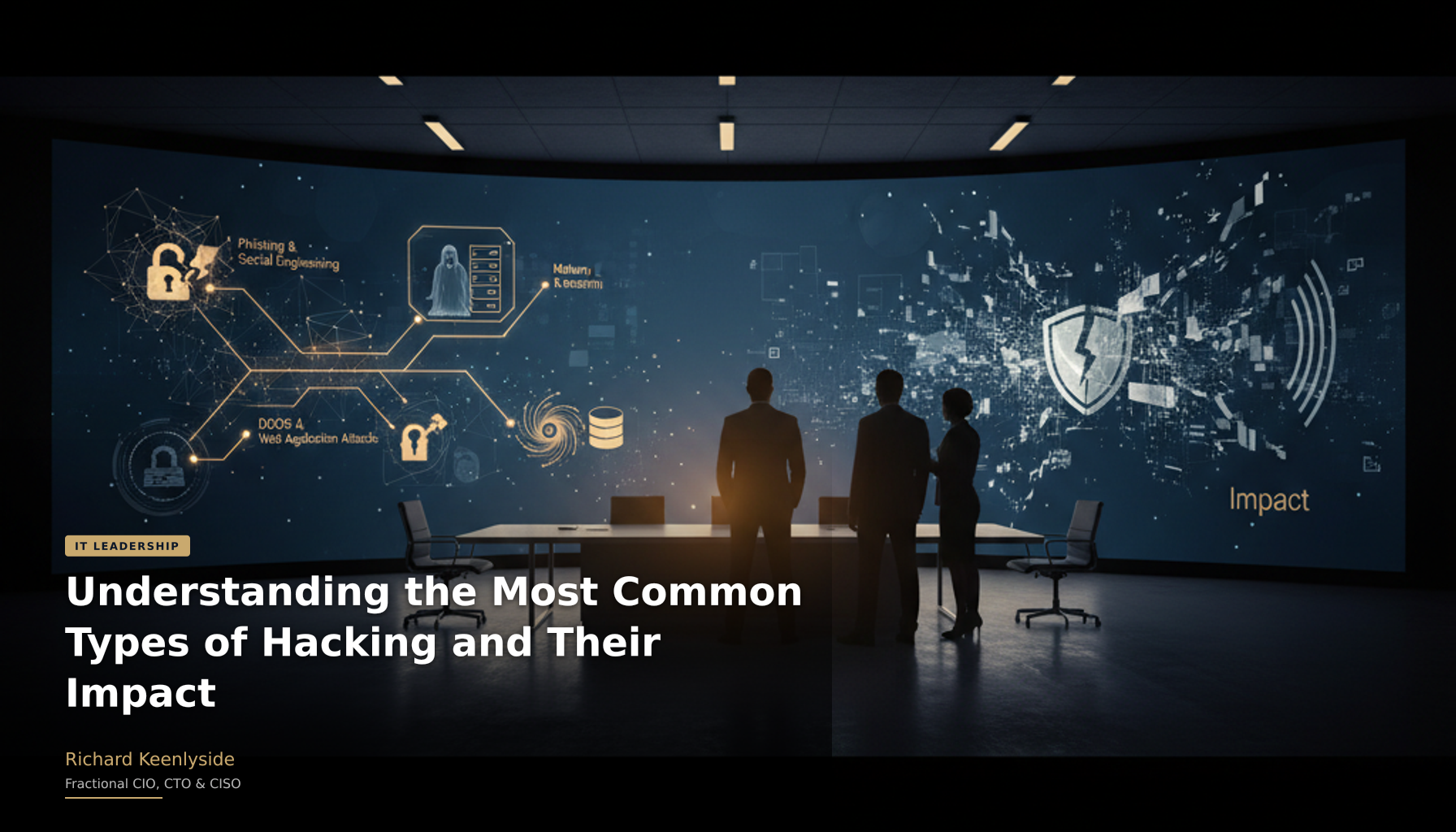
While hacking methodologies continually advance, several core types remain pervasive. Their impact ranges from data theft and service disruption to financial fraud and espionage. Here is a breakdown of some of the most common hacking types:
- Phishing Attacks - These rely on deception, tricking users into revealing credentials or downloading malware. Spear-phishing escalates this by personalising the attack, making it harder to detect.
- Ransomware - Malicious software encrypts data or locks system access through extortion tactics demanding payment. The level of operational paralysis can be catastrophic.
- SQL Injection - This exploits vulnerabilities in web application databases, allowing attackers to manipulate or exfiltrate data by injecting malicious code into query strings.
- Man-in-the-Middle (MitM) Attacks - Attackers intercept communications between two parties, potentially altering information or stealing data without either party’s knowledge.
- Distributed Denial of Service (DDoS) - This flood-based attack overwhelms servers, rendering services unavailable and disrupting business continuity.
- Credential Stuffing - Automated attempts to access accounts using large volumes of compromised username-password pairs, often resulting from data breaches elsewhere.
Recognising these common hacking types enables targeted defence measures, optimising resource allocation and reducing exposure.
Impact of Common Hacking Types on Business
The consequences of successful hacking are not one-dimensional. Beyond technical and immediate impacts, attacks often have strategic implications that affect long-term business viability. I regularly witness organisations facing extended recovery periods after ransomware hits, given the complexity of restoring affected systems and verifying data integrity.
Phishing remains one of the top hacking types leading to credential compromise and subsequent insider-like breaches. For example, in a recent engagement with a PE-backed firm, phishing was the initial vector that allowed attackers to escalate privileges and siphon sensitive intellectual property unnoticed for months. This underscores the importance of continuous staff education combined with multi-layered technical controls.
Furthermore, sophisticated SQL injection attacks can quietly expose customer data, provoking costly regulatory fines and eroding customer confidence. MitM attacks, while less talked about, increasingly target mobile and remote working environments, exploiting weaker public network security. DDoS attacks affect customer experience and trust, especially for online service providers, where availability directly correlates with revenue.
Understanding these diverse effects guides leaders to appreciate that cybersecurity is not only a technology issue but a critical business risk deserving board-level focus.
Common Mistakes to Avoid When Addressing Hacking Threats
- Underestimating the sophistication and persistence of attackers, leading to inadequate security measures.
- Over-reliance on perimeter defences while neglecting internal monitoring and incident response capabilities.
- Failing to regularly update and patch systems, allowing known vulnerabilities to persist.
- Ignoring employee training and awareness, despite phishing remaining one of the top hacking types exploited.
- Neglecting to enforce strong authentication methods such as multi-factor authentication, particularly for privileged accounts.
- Not conducting regular threat modelling or penetration testing to identify real-world exposure.
Frequently Asked Questions
What is the most common hacking type I should prepare for?
Phishing is the most widespread attack vector, responsible for a significant portion of breaches. Preparing your organisation with robust email filtering, user awareness training, and verification controls is crucial to mitigate this risk effectively.
How can ransomware impact my business beyond just data loss?
Ransomware often causes extended downtime as systems are locked or encrypted, affecting operational continuity. Additionally, trust erosion, potential regulatory fines, and expensive recovery costs can compound the direct technical damage.
Is multi-factor authentication effective against all hacking types?
Multi-factor authentication significantly reduces risks related to credential theft and reuse, such as phishing or credential stuffing. While it does not prevent all attack types, it is a critical element in reducing successful unauthorised access.
In conclusion, recognising and understanding the most common hacking types equips organisations with the insight to safeguard their assets and continuity. Hacking types continue to evolve, but by focusing on the prevalent methods and their business impact, leaders can make informed decisions that substantially improve security posture. Knowledge is a powerful defence in the ongoing cyber threat landscape.
How Richard Can Help
Need Experienced Technology Leadership?
Whether you need an interim CIO to stabilise operations, a fractional CIO for strategic oversight, or a trusted technology advisor to challenge your current direction, I work alongside leadership teams to deliver real outcomes. With over 37 years of experience across UK and international organisations, I provide the depth of expertise your business needs.