Technology Due Diligence vs IT Audit: What Private Equity Firms Actually Need
Private equity transactions involving technology-intensive companies often require a thorough assessment of IT capabilities, yet the distinction between technology due diligence vs IT audit remains misunderstood. In my experience leading numerous PE buy-side technology assessments, over 60% of firms confuse these two, risking costly oversights. Understanding what each process entails is critical to making informed investment decisions that align with growth and risk strategies.
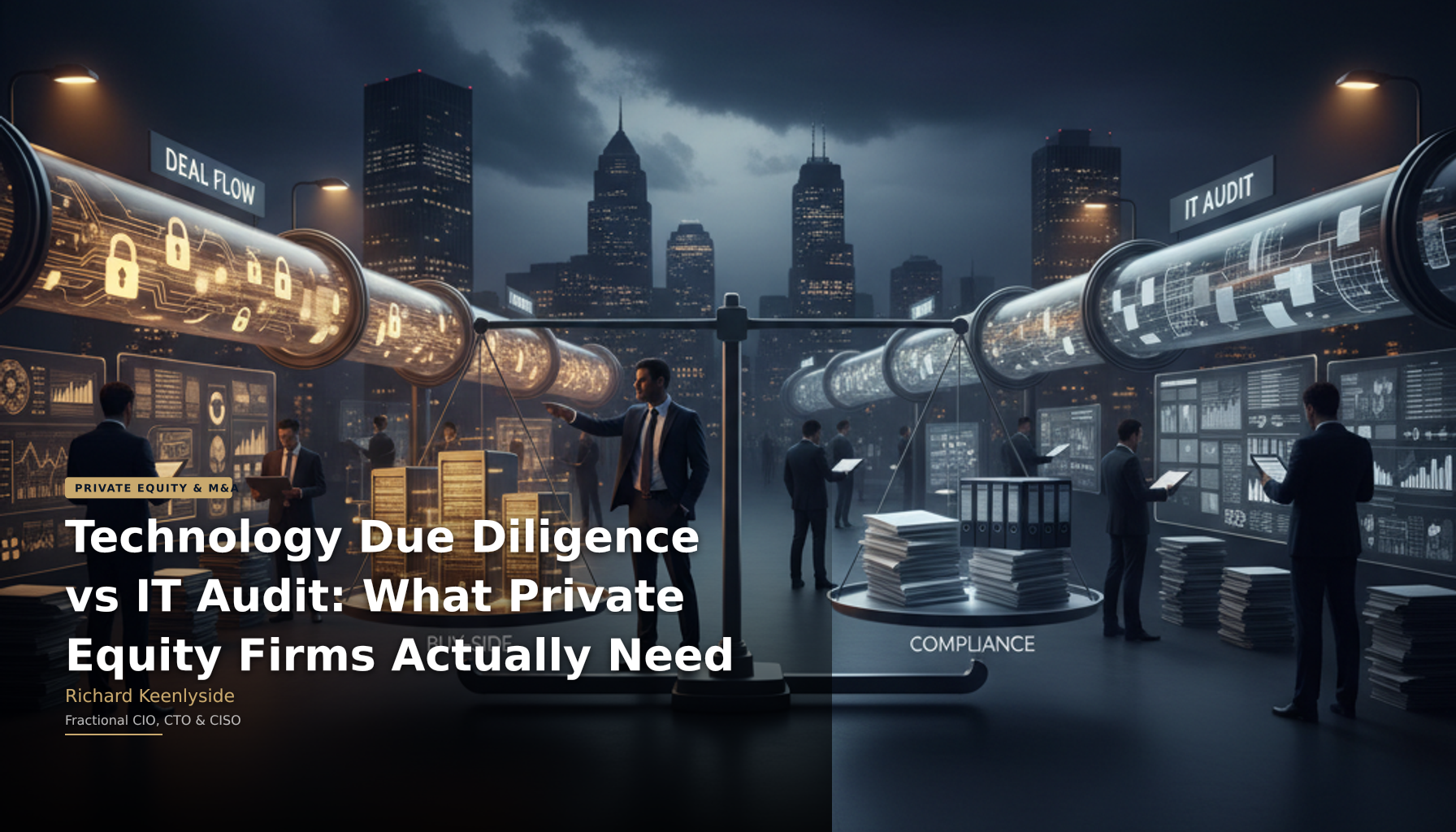
Why Distinguishing Technology Due Diligence from IT Audit Matters for Private Equity
Private equity firms operate under intense deal timelines and financial scrutiny, necessitating clear insights into technology risks and potential. Technology due diligence UK offers a forward-looking diligence approach that evaluates not just compliance, but strategic alignment, scalability, and controls effectiveness. In contrast, an IT audit primarily focuses on compliance with standards such as ISO 27001 or SOC 2 at a point in time.
Without appreciating these differences, PE investors may rely on insufficient assessments that overlook critical operational, technical, and security risks. This can lead to undervalued technology liabilities, integration delays, and sometimes, catastrophic failure to realise expected value post-acquisition. The right approach requires clarity on what the deal demands technically, financially, and operationally.
Technology Due Diligence vs IT Audit: What Private Equity Firms Should Focus On
When comparing technology due diligence and IT audits for PE buy-side technology assessment, the objectives and outputs differ significantly. A fractional CIO or programme director is often engaged specifically to bridge the gap between technical evaluation and strategic investment decisions. Key features that differentiate technology due diligence include:
- Strategic Depth: Technology due diligence assesses the scalability of IT architecture, product development lifecycle, and alignment to business goals. It evaluates whether technology is an enabler or inhibitor for future growth.
- Risk Identification & Mitigation: It focuses on identifying legacy technology risks, vendor dependencies, cybersecurity posture including SOC 2 and ISO 27001 controls audit findings, and incident response maturity, offering actionable recommendations.
- People and Processes: The assessment considers IT team capability, organisational structure, and governance frameworks, ensuring the company’s technology function can support growth post-deal.
- Forward-Looking Diligence: Rather than looking backwards at compliance snapshots, technology due diligence forecasts IT operational risks and capital expenditure needs that could impact deal valuation or earn-out clauses.
On the other hand, an IT audit is primarily compliance-oriented, often managed internally or by third-party auditors to check adherence to standards such as ISO 27001 or SOC 2. It produces reports on gaps against controls frameworks but lacks the business context and strategic perspective vital for PE buy-side decision-making.
Deeper Analysis: The Role of a Fractional CIO and Programme Director in Technology Due Diligence
From my vantage point leading engagements as a fractional CIO and programme director, I have found that private equity firms gain disproportionately when technology due diligence integrates seasoned leadership early. This approach moves beyond surface-level controls audit results to interpret findings within the business and investment landscape.
For example, during a recent UK PE deal involving a fast-growing scale-up, the SOC 2 audit showed compliance, but the technology due diligence uncovered significant build versus buy risks in the cloud infrastructure strategy. As fractional CIO, I advised the investment committee on latent operational risks and the capital expenditure required for remediation. This level of insight ensured appropriate pricing and negotiation of deal terms that fully reflected technology realities.
The key takeaway is that technology due diligence must be infused with practical experience and programme delivery insight. Investing in a fractional CIO or a programme director for the due diligence scope enables leadership to translate audit data into strategic guidance relevant for PE investors seeking value creation not just compliance assurance.
Common Mistakes to Avoid in Technology Due Diligence and IT Assessment
- Confusing IT audits as comprehensive technology due diligence and relying solely on audit reports for investment decisions.
- Engaging technology assessors without PE-specific experience or understanding of buy-side deal dynamics.
- Failing to include a forward-looking diligence perspective that evaluates scale-up readiness and post-deal transformation risks.
- Neglecting the assessment of technology leadership, organisational capability, and governance as part of the due diligence process.
- Assuming compliance with standards like ISO 27001 or SOC 2 equates to minimal cyber risk exposure.
- Overlooking integration complexity and technology debt revealed only through detailed technology due diligence.
Frequently Asked Questions
What is the primary difference between technology due diligence and an IT audit?
Technology due diligence is a strategic, forward-looking evaluation aimed at understanding technology capability, risks, and scalability in the context of the business and investment goals. IT audits focus mainly on checking compliance against specific standards like ISO 27001 or SOC 2, providing a snapshot of control effectiveness at a point in time.
Why should private equity firms engage a fractional CIO during due diligence?
A fractional CIO brings practical IT leadership experience tailored to PE deal dynamics, allowing deeper interpretation of technology risks and opportunities beyond audits. They help integrate findings into deal strategy, ensuring informed decision-making and value realisation post-investment.
Is SOC 2 certification sufficient to satisfy technology due diligence requirements?
SOC 2 certification indicates that certain controls meet standards for security and availability, but it does not assess technology scalability, operational risks, or strategic alignment. Hence, while it adds value, it should complement broader technology due diligence rather than replace it.
In summary, private equity firms aiming to unlock technology value and mitigate risks need to distinguish technology due diligence from IT audit clearly. Forward-looking diligence driven by experienced fractional CIOs or programme directors reveals nuances that static controls audits miss, forming a robust foundation for successful PE buy-side technology assessments. Understanding this difference enables confident investment decisions that drive growth and operational excellence.
How Richard Can Help
Technology Due Diligence and Post-Acquisition Integration
I work with PE firms, corporate acquirers, and portfolio company management teams on technology due diligence, pre-acquisition risk assessment, and post-merger integration planning. If you need an independent technology leader who understands the commercial pressures of M&A, I can provide the rigour and pace that transactions demand.