Do You Need a CIO, a CISO, or Both? A Practical Decision Framework
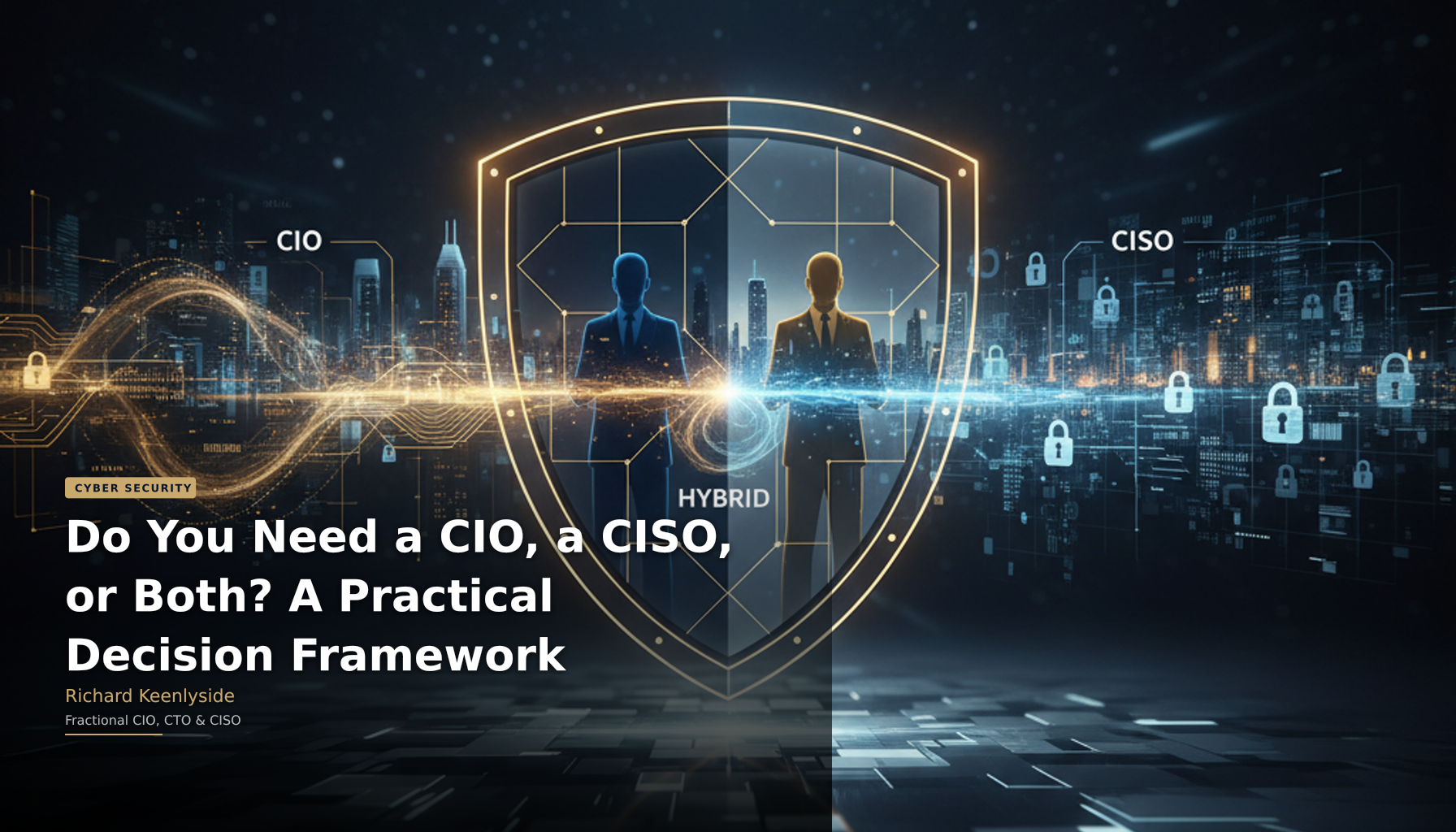
In today’s complex IT environments, the question of whether to appoint a dedicated CIO, a CISO, or a CIO CISO hybrid is increasingly common, especially among mid-market firms striving to balance innovation with security. From my experience working with over 50 mid-market CIOs, a recurring challenge is ensuring comprehensive technology security leadership without creating organisational friction or duplication.
Why This Matters for Mid-Market Businesses
Mid-market companies face unique pressures that make technology security leadership a critical concern. Unlike enterprises with the resources for expansive IT and security teams, mid-market firms typically operate with constrained budgets and leaner staff structures. This reality often leads to underdeveloped security postures or fragmented technology oversight, which in turn raises the risk of data breaches, compliance failures, and operational disruption.
Without a clear technology leadership framework, businesses can suffer from siloed decision-making, unclear accountability, and missed opportunities to leverage technology as a strategic asset. This is why understanding whether your organisation needs a dedicated Chief Information Officer (CIO), Chief Information Security Officer (CISO), or a hybrid solution is essential for resilience and growth.
The CIO CISO Hybrid: A Strategic Solution for Technology Security Leadership
The concept of a CIO CISO hybrid, where a single dual-hat executive holds responsibility for both technology leadership and security governance, has gained traction as a practical model for mid-market businesses. This approach consolidates oversight, streamlines communication, and can drive alignment between IT strategy and security imperatives.
- Integrated Decision-Making: A dual-hat executive promotes cohesive strategy development and prioritisation of cybersecurity within the broader technology roadmap, avoiding typical conflicts between innovation and risk mitigation.
- Resource Efficiency: Mid-market firms often cannot justify separate C-suite roles for IT and security. A CIO CISO hybrid maximises executive impact while optimising budget and headcount.
- Clear Accountability: With combined responsibility, the risk of security gaps caused by misaligned ownership diminishes. The dual role ensures all technology initiatives consider security from inception through to delivery.
To succeed, the individual assuming this hybrid role must possess a rare blend of business acumen, technical expertise, and security experience. I have observed that mid-market CIOs excelling in this dual capacity often come from backgrounds that combine infrastructure management with cyber risk or governance.
Balancing the Dual-Hat Role: Challenges and Real-World Patterns
While the CIO CISO hybrid can be effective, it is not without challenges. The dual-hat executive must continually balance competing priorities, such as driving digital transformation while defending against rapidly evolving threats. In several engagements, I have seen the following patterns emerge:
- Time Allocation Pressure: Security incidents demand immediate attention, which can disrupt broader IT strategy execution if not carefully managed.
- Skills Diversification: Keeping current with both strategic IT trends and detailed security frameworks requires ongoing investment in knowledge and professional development.
- Organisational Support: Success often depends on robust structures beneath the executive level, including empowered security teams and clear governance processes.
A concrete example involves a PE-backed manufacturing firm where I served as a fractional CIO CISO. The hybrid model enabled swift implementation of key cyber hygiene improvements without sacrificing the momentum of a cloud migration programme. However, we ensured strong delegation by appointing a security manager responsible for day-to-day risk monitoring, which allowed the executive to focus strategically.
Common Mistakes to Avoid with CIO CISO Hybrid Roles
- Assuming the hybrid role suits all companies regardless of complexity or scale - some businesses require specialised focus and dedicated leaders.
- Underestimating the executive bandwidth needed to cover both strategic IT leadership and detailed security governance effectively.
- Failing to invest in subordinate teams and clear processes to support the dual role, leading to bottlenecks or oversight failures.
- Ignoring potential conflicts of interest where IT innovation goals may overshadow necessary security controls without proper governance frameworks.
- Neglecting continuous professional development in one or both domains resulting in outdated practices that put the organisation at risk.
- Overlooking the cultural and communication challenges that arise from consolidating these traditionally separate functions.
Frequently Asked Questions
When is a CIO CISO hybrid suitable for a mid-market organisation?
This model works best for mid-market firms with limited budgets that need a unified technology and security strategy but do not yet require separate full-time leaders for each domain. It is suitable when a single executive has the skills and capacity to manage both areas effectively and where strong support structures exist below the C-suite.
What are the key skills a successful dual-hat executive must have?
A successful CIO CISO hybrid needs comprehensive IT strategy expertise, in-depth cybersecurity knowledge, strong risk management capabilities, and excellent stakeholder communication skills. They must adeptly balance innovation with protection and maintain vigilance on emerging threats without losing sight of business objectives.
How can firms avoid conflicts between IT innovation and security in a hybrid role?
Establishing clear governance frameworks, embedding security early in project lifecycles, and fostering a culture of risk-aware innovation are essential. The dual-hat executive must advocate for security as a business enabler and work closely with business units to align priorities constructively.
In summary, deciding whether you need a CIO, a CISO, or embrace a CIO CISO hybrid approach hinges on your organisation’s size, complexity, and resource availability. The dual-hat executive model offers a pragmatic, cost-effective path to robust technology security leadership for many mid-market CIOs. However, success depends on choosing the right individual and supporting them with appropriate governance and team structures to ensure balanced and effective oversight.
How Richard Can Help
Strengthen Your Organisation's Cyber Security Posture
If your business needs a fractional CISO, expert preparation for Cyber Essentials, ISO 27001, or DORA compliance, or independent assurance of your current security programme, I can provide hands-on leadership and practical guidance. I have led security programmes across regulated and unregulated sectors and can help you build defences that are proportionate, effective, and board-ready.