Key Statistics
- 73% of UK CIOs identify AI augmentation as a top priority for improving decision-making in 2024 (Gartner, 2024)
- By 2025, 45% of UK enterprises plan to increase investment in intelligent automation to reduce operational costs (McKinsey, 2025)
- Only 28% of UK organisations have fully integrated AI augmentation tools into their core business processes (ONS, 2024)
- UK businesses report a 30% average productivity gain after combining AI augmentation with automation versus automation alone (Accenture, 2024)
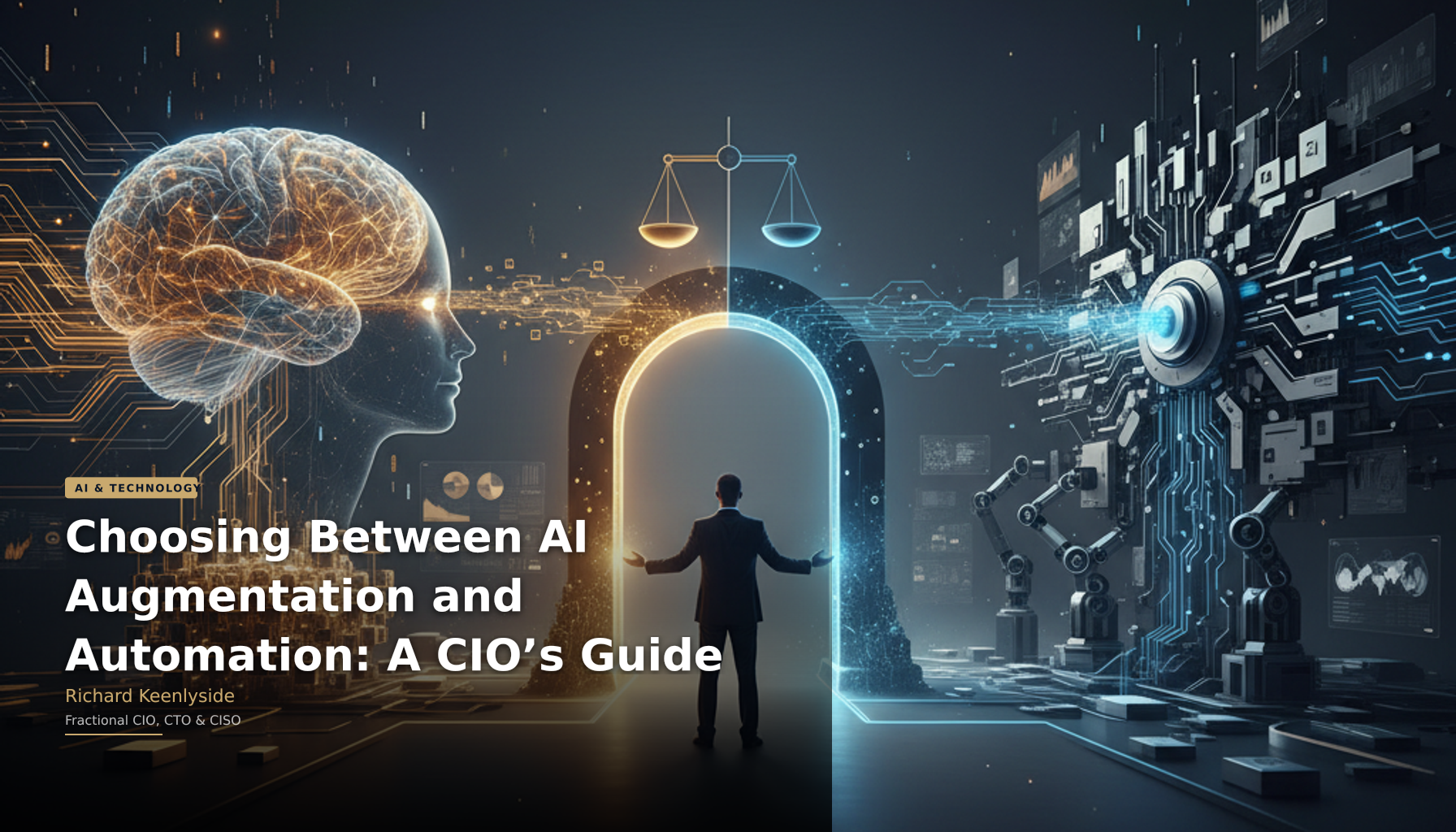
Choosing Between AI Augmentation and Automation: A CIO’s Guide
In my experience advising UK enterprises, the distinction between AI augmentation vs automation is more than a technical debate - it defines the future of competitive advantage. While automation delivers consistent efficiency gains, AI augmentation empowers decision makers with intelligent insights, often driving long-term strategic value. Yet many CIOs struggle to quantify and showcase the benefits beyond cost savings, missing a critical opportunity to influence business outcomes.
Why This Matters to CIOs and Business Leaders
Today’s CIOs face immense pressure to do more with less, balancing operational resilience with rapid innovation. Automation is often seen as the obvious tool to slash costs and reduce manual errors, but those gains can plateau quickly. The real challenge is overcoming diminishing returns while unlocking new business value - which is where AI augmentation plays a transformative role.
Without a clear differentiation and strategic prioritisation of AI augmentation over pure automation, organisations risk settling for incremental improvements rather than step changes. This is especially true in sectors where decision speed, quality, and context awareness are paramount, such as financial services, healthcare, and advanced manufacturing. Failing to harness augmentation capabilities can leave businesses vulnerable to competitors who better leverage intelligent technology for innovation-led growth.
AI Augmentation vs Automation: What CIOs Need to Know
Understanding the nuances between these two approaches is foundational to making informed investments and managing expectations within the boardroom.
- Automation: At its core, automation focuses on mechanising repeatable, rules-based tasks to improve efficiency and reduce human labour. Typical examples include robotic process automation (RPA) for invoice processing or IT operational workflows.
- AI Augmentation: Unlike traditional automation, AI augmentation enhances human decision making by providing contextual insights, predictions, and recommendations. This extends beyond routine operations into complex areas such as fraud detection, customer experience personalisation, and dynamic supply chain optimisation.
- Scope of Impact: Automation tends to optimise existing processes, often yielding short to medium-term cost savings. In contrast, AI augmentation can enable new capabilities and open pathways to innovation, influencing strategic outcomes and new revenue streams.
- Human Factor: Automation aims to reduce reliance on manual intervention, which can sometimes limit adaptability. Augmentation keeps humans "in the loop" to apply judgement, creativity and ethical considerations, which is critical for regulated industries.
For CIO priorities, the key is not merely adopting automation or AI but designing integrated strategies where intelligent automation enables decision augmentation, driving smarter workflows and business insights.
Strategic Example: How AI Augmentation Delivered Value in a PE-backed Scale-up
Working as a fractional CIO in a UK financial services scale-up recently, I witnessed a compelling example where AI augmentation outperformed basic automation. The company initially aimed to cut processing costs through automation of compliance checks. While successful in reducing manual effort, it soon hit a plateau as exceptions and new regulations increased.
We shifted focus to AI augmentation, deploying machine learning models to analyse complex datasets and flag nuanced risk profiles for human specialists to review. This intelligent approach accelerated detection of potential compliance breaches, improved accuracy, and freed skilled staff for higher-value work. The outcome was not only operational efficiency but stronger regulatory posture and faster onboarding of clients.
This case illustrates how AI augmentation supports dynamic decision-making environments and enhances human expertise rather than simply replacing it. It also highlights why boards should expect CIOs to articulate this value clearly, aligning technology investments with measurable business benefit.
Common Mistakes CIOs Should Avoid When Choosing Between AI Augmentation and Automation
- Confusing automation with AI augmentation - treating them as interchangeable rather than complementary capabilities.
- Focusing solely on cost reduction metrics instead of broader KPIs such as decision quality, speed, and customer satisfaction.
- Underestimating the change management required to integrate AI-augmented workflows effectively with existing teams.
- Ignoring data quality challenges that undermine AI model performance and erosion of trust in augmented decisions.
- Over-automating without retaining human oversight, risking rigidity and ethical blind spots.
- Failing to establish governance frameworks that monitor AI augmentation impact and compliance risks continuously.
Frequently Asked Questions
What is the fundamental difference between AI augmentation and automation?
Automation automates rule-based, repetitive tasks to improve operational efficiency, often removing human involvement. AI augmentation, however, uses AI technologies to enhance human decision making by providing insights and recommendations, keeping humans actively involved in the process.
How can CIOs measure the success of AI augmentation initiatives?
Beyond cost savings, success metrics include improved decision accuracy, faster cycle times, employee satisfaction with decision support tools, regulatory compliance improvements, and new business opportunities unlocked through enhanced insights.
Is it better to prioritise automation or AI augmentation first?
The right approach depends on organisational maturity, data readiness, and strategic goals. Many firms start with automating simple processes for quick wins and then progressively embed augmentation capabilities to capture greater, sustainable value through smarter decision making.
In conclusion, CIOs must recognise that AI augmentation vs automation is not an either/or choice but a strategic continuum. Prioritising AI augmentation empowers businesses to build resilient, adaptive capabilities that drive competitive advantage, far beyond the efficiency gains typical of pure automation. From my perspective as a fractional CIO working across founder-led and PE-backed organisations, embracing this distinction is essential to delivering meaningful, long-lasting impact in 2026 and beyond.
How Richard Can Help
Make AI Work for Your Business
Most organisations are asking the same question: how do we capture real value from AI without the risk and noise? I help leadership teams develop practical AI strategies grounded in business outcomes, not vendor hype. If your board is ready to move from experimentation to execution, I would welcome a conversation about what is genuinely possible for your organisation.